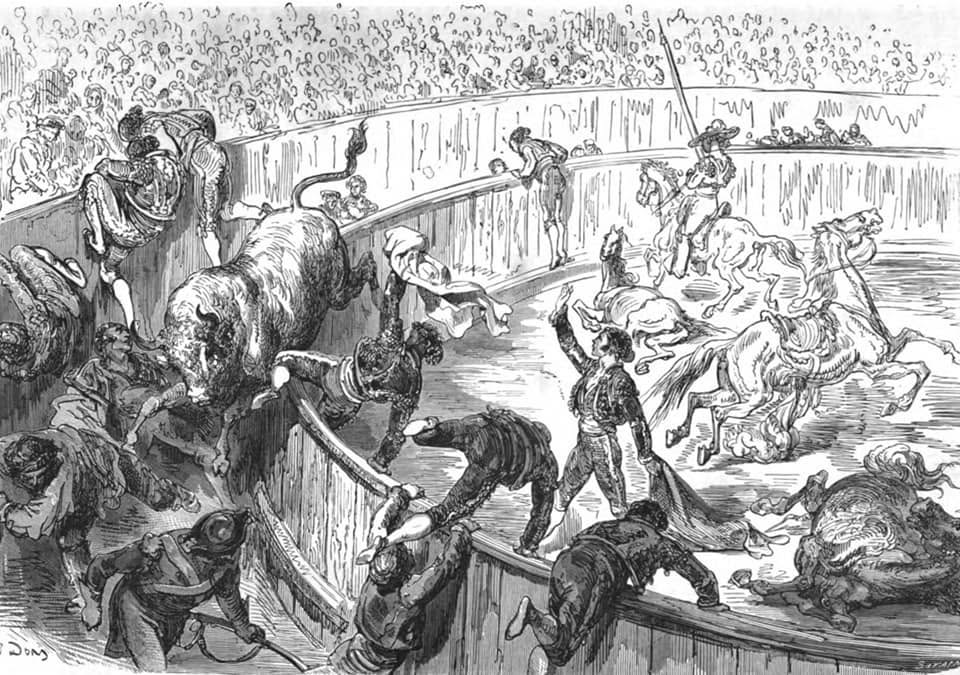
In the context of chivalric bullfighting, the riders were aristocrats. Bullfighting was a way to demonstrate one's superiority, both in terms of courage and economic and political power, if only through the extravagance of their appearances.
When these lords retire, the lackeys and other matatoros find themselves unemployed. They decide to continue bullfighting, but from now on, they will do it for themselves.
The varilargueros , who replaced the caballeros, were also men of low origin.
Horsemen and matadors on foot are now equal. There is no longer a social hierarchy.
The matadors, believing they no longer have any reason to remain subordinate, will then seek to attract public attention. Furthermore, they must justify their presence in the ring.
By shining so brightly, they then enter into open rivalry with the riders.
One of them was named Francisco Romero. He would become the founder of the most illustrious bullfighting dynasty of the 18th century.
In addition to these unemployed footmen, there was another breeding ground from which some of the first professional bullfighters emerged . This was the slaughterhouses, particularly those of Cadiz and Seville, where large quantities of wild cattle were processed. The butcher boys there were very skilled at killing the bulls. In the corrals, new techniques were developed that they would later apply in the ring. (3)
A new practice also became widespread: the use of the muleta , literally "the crutch," a wooden support around which the cloth is wrapped. This tool allows for greater precision and finesse in the movement, frees up one hand, and opens up a number of possibilities. This invention is attributed by some to Francisco Romero, others to Miguel Bellon El Africano in 1720, but documents mention its sporadic use for much longer.
In any case, the tercio de mort is evolving, so are the tastes of the public, and the matadors are engaging in a tug-of-war with the horsemen.
At the same time, the first recognized breeders began to emerge: Tadeo Guendulain, José Jijon, José Rafael Cabrera, Gregorio Vazquez, Juan José Becquer, Benito Ulloa, the Count of Vistahermosa…. These were bourgeois and merchants who quickly realized that the bull for the arenas was better paid than the bull for meat, but that in addition, it could offer glory.
Thus, using still rudimentary methods, they began to raise and select the cattle. This gave rise to what are known as the Founding Castes, primitive breeds upon which the Raza Brava would be built . There are seven of them: Castellana, Jijona, Navarra, Cabrera, Gallardo, Vazquez, and Vistahermosa. The majority have disappeared today, with modern herds primarily based on the Vistahermosa rootstock. To draw a parallel with the world of wine, these would be the grape varieties.
Finally, in order to finance the court hospitals, in 1754, King Ferdinand VI authorized the construction of Madrid's first permanent bullring at the Puerta de Alcalá. Most major cities then built arenas based on this same model. Bullfighting finally had its dedicated venue: the "plaza de toros ," the bullring. It's worth noting that this also marked the beginning of professional bullfighting as a lucrative spectacle.
At the beginning of the 19th century , everything was in place to allow these groups of bullfighters to clash, with the aim of establishing themselves and dominating the nascent bullfighting scene.
This struggle will gradually turn to the advantage of the men on foot.
In 1836, a matador named Francisco Montes Paquiro published his “Complete Bullfighting,” which served as the basis for the bullfighting regulations in Madrid's bullrings in 1852 under the authority of Melchor Ordoñez, then governor of the Spanish capital. He laid out the definitive framework of the modern bullfight, structuring the spectacle around identified and recognized bulls from specific ranches, each fought by a matador accompanied by his team, his cuadrilla . Furthermore, each bull would be fought in three distinct tercios (acts), following an established protocol, ending with the death of the animal at the conclusion of the third tercio.
Modern bullfighting was born.
The 20th century will see many revolutions in the arena, but they will focus on the way of bullfighting, the style and the technique, but not on the course of events.
Thus, with some difficulty, and taking a few shortcuts, we have covered nearly 25000 years of history in about ten pages.