farmhouses
Leaving Seville for the countryside, the landscape changes quickly. White facades give way to horizons of holm oaks, pastures, and fields. In the middle of this landscape, a cluster of low, solid, whitewashed buildings sometimes appears: the cortijo. It is one of the most emblematic features of rural Andalusia.
An architecture born from the earth
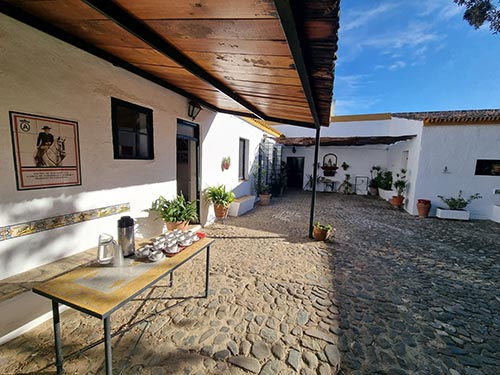
The cortijo is not a simple farm. It is a small, self-sufficient village, designed to support a large estate. Its architecture responds to very concrete constraints: sun, heat, and isolation.
The thick, whitewashed walls keep out the summer heat. The terracotta tile roofs protect the interior spaces. The central patio, the heart of daily life, provides shade and coolness. Around it are arranged the main house, the workers' quarters, the stables, the barns, and sometimes a small chapel. Everything is designed so that the estate can be almost self-sufficient.
Centuries of history
The origins of the cortijo date back to the centuries following the Reconquista, when vast lands were redistributed and organized into large estates. Over time, these estates became the cornerstone of the Andalusian economy: cereals, olive groves, and livestock. Around the cortijo revolved a whole community of cattle herders, shepherds, and cattlemen, whose skills were passed down from generation to generation.
This model shaped Andalusian society as much as its landscapes. It also gave rise to traditions that endure: life on horseback, working cattle outdoors, and a culture of hospitality towards passing travelers.
The soul of the place
What strikes you upon arriving at a cortijo is first and foremost the calm. Time follows a different rhythm there, that of the seasons and the animals. You discover a way of life that is anything but folkloric: the estate remains a place of work, where every gesture has meaning.
Campo Bravo, a living cortijo
It is in this setting that we welcome our visitors. Our estate covers 600 hectares, including 350 hectares of dehesa, this unique ecosystem of holm oaks and pastures, complemented by dryland crops and a breeding area. It is home to a herd of Brave breed fighting bulls, which roam freely on these lands, as well as our Pura Raza Española horses.
Here, the cortijo is not a backdrop: it is the center of a working farm. As you walk through it, you discover its patios, its outbuildings and the organization of an estate as it has always functioned, then you go to meet the livestock in the dehesa.
That's the whole difference with mass tourism. Rather than looking at Andalusia through a window, you experience it: you breathe the country air, you listen to those who work there and you understand what has shaped this region.
The Andalusian cortijo is not just something to visit: it's something to experience. Come and discover it at Campo Bravo.